
Use Cases
A Business Simulation in Use
A simulation for a better understanding of corporate financial management
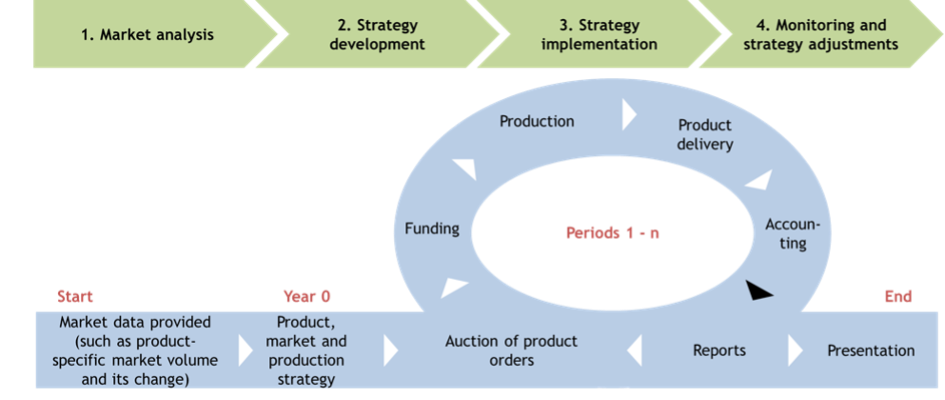
The Business Simulation shows students which financial aspects need to be considered in company management and how the individual areas of the company are connected in terms of their financial impact. The board game enables students to playfully experience the connections between the goods cycle and the money cycle of a company.

A possible playthrough is shown below:
Necessary Theoretical Background
Prior basic knowledge in the field of and corporate finance is required in order that players can profit the most from the game setting. A general introduction and additional inputs within the game help to refresh and recall the knowledge. The short theoretical inputs are intended to increase the students' knowledge and give them the opportunity to apply the knowledge in their own company.
A main target of the Business Simulation is to let the students understand and experience the following decisions made in a company:
- Capital budgeting: Decision on which product and market developments the company invests in.
- Capital structure: Decision on how much debt and equity the company uses for financing.
- Corporate strategy: Deciding in which direction a company should steer, which products should be offered in which markets, and the coordination of investments and financing of the company.
It is not required that the students are able to prepare an income statement and a balance sheet. A basic understanding of the mechanisms is sufficient. Throughout the game, players gain a deeper understanding of the materials.
Target Group
The simulation is suitable for various target groups with a basic knowledge of accounting and corporate finance. In addition to students at universities of applied sciences and universities, the simulation can be used very well in continuing education.
The simulation makes it easier to understand the interplay of financial issues in the different areas of a company, so that players achieve a higher level of understanding according to the Learning Objective taxonomy. It promotes understanding of other areas. In addition, the use of a board game enables increased communication between people and simplifies the exchange between different groups.
Course Design
Using the Business Simulation requires a lot of in-class time. Thus, a playing time of less than one and a half days is not recommended. Due to the investment elements, at least five periods should be completed. Between the game, lectures on theoretical and practice-oriented topics regarding the financial management of a company enrich the seminar.
Compact Seminar/Course
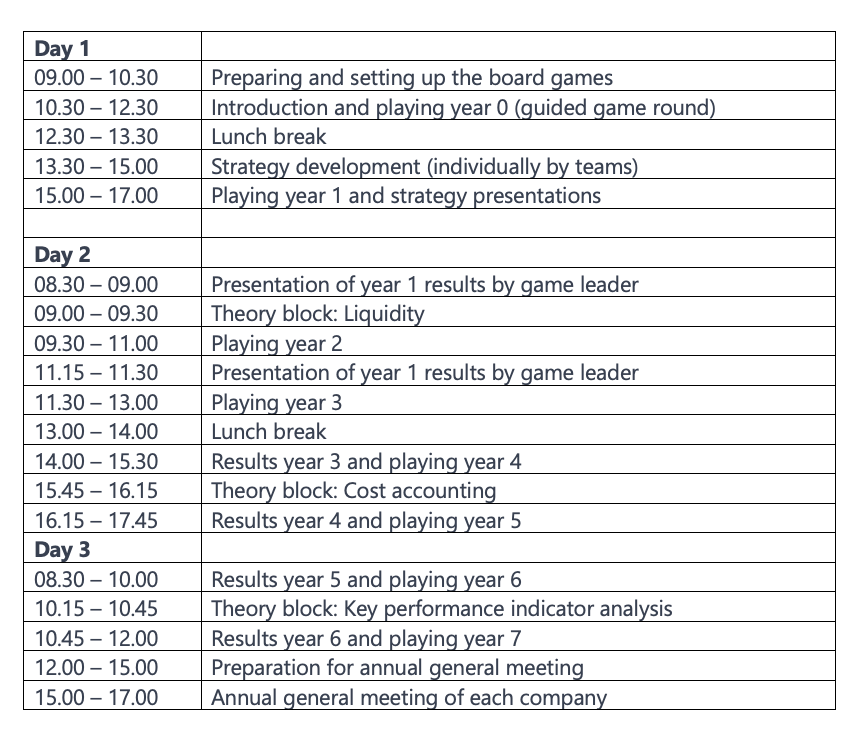
Below is an exemplary syllabus of the three-day seminar, which includes theoretical input lectures as well as game and results explanation phases.
Asssessment Design
Using a simulation like the Business Simulation in class allows aiming at higher levels within the Learning Objective taxonomy. For example, instead of a simple multiple-choice exam where the passive knowledge of the students is being tested, students can be asked to apply, analyze and evaluate their knowledge and, e.g., elaborate the outcome of the game.
Any of the following elements or any combination / weighting thereof can be used as an academic assessment:
- Presentation: e.g., hold a annual general meeting or conduct a financial analyst meeting, in which students explain their strategy and simulation decisions to their analyst
- Written assignment: e.g., design an annual report resembling a real-life annual report, including a summary of the game performance and strategy/major decisions.
- Game performance: e.g., game stock price development, performance measures (return on investment or equity), total earnings as a company.
Final Summary
Business simulations provide an immersive and risk-free environment for learners to apply theoretical concepts, develop critical thinking, and improve decision-making skills. These interactive experiences foster collaboration, strategic planning, and adaptability - preparing participants to confidently navigate complex business landscapes. By bridging the gap between classroom learning and practical application, such a business simulation equips students and professionals with experiential knowledge and competences.